The whole hormone conversation rests on one mistake that gets repeated so often nobody sees it anymore.
A hormone is treated as the cause. Most of the time it's the output.
When someone's testosterone comes back low, people talk about it as if that were the disease. But a hormone is a message about the state the rest of the system is in. It's a number that comes out of sleep, food, light, movement, stress and age.
If you raise that number from the outside, you've changed the message. You haven't changed what the message was about.
The question of this submodule: if a hormone is an output, what's the input, and can you do anything about it?
Testosterone: what actually determines it
Let's start where the best evidence is, and there's nothing esoteric about it.
Sleep. There's an experiment worth knowing, because it's clean and short. Healthy young men had their sleep cut to about five hours for one week. Their daytime testosterone dropped by double-digit percentages.
In one week. In healthy young men. Without a single other change.
Think about what that means for someone who has been sleeping five hours for years.
Fat in the diet. Sex hormones are built from cholesterol. Anyone who eats very low-fat for a long time is taking building material away from the body. See 4.3.
Strength training. Lifting heavy things is one of the few signals that tells the body it makes sense to build muscle.
Light and rhythm. Hormones run on a daily cycle. When the cycle is broken, so are they. See 3.1.
Chronic stress. Long-term tension works against building. A body in survival mode doesn't invest in reproduction or in muscle.
Body fat at either extreme. Too much and too little. The middle beats either end here.
Notice what isn’t on that list. No supplement, no booster, no pill. It’s sleep, food, load, light and calm. That’s all of Modules 3 and 4.
TRT
Because every other person is going to ask about it.
It works. I'm not going to pretend it doesn't. If you take testosterone from the outside, your level will be higher and you'll usually feel better.
And at the same time, something's true that rarely gets said. When you get it from the outside, your body stops making its own. And getting off it is harder than getting on. For most people it's a decision for life, even if it doesn't look that way at the start.
That leads to a stance that's neither condemning nor recommending. It's treatment, not a supplement.
What is absurd, though, is the order people do it in. Someone sleeps five hours, eats low-fat, never sees the sun, lives in chronic stress, and fixes it with an injection.
Exhaust what's free first. If after a year of sleep, food and training the number is still low, that's a different conversation. But only then.
Women: the cycle is a vital sign
And now the part most men's courses skip, which is a mistake.
A regular cycle isn't a nuisance to push through. It's a sign the system is running.
Whether it's regular, how heavy it is and how a woman handles it is one of the best feedback signals in this whole area. Better than most blood tests.
When the cycle stops or goes irregular, the body is saying it's too much. Too little food, too much training, too little sleep, too much stress, or all of it together.
It's not a sign she needs to add more. It's a sign she needs to cut back.
And one more thing that rarely gets said. Hormonal birth control switches that signal off. The bleeding on it isn't a cycle. It's a reaction to stopping the pill. That doesn't mean nobody should take it. It means that whoever takes it has lost one of the best markers she had.
The thyroid and iodine
A short section that ties into 4.2, because here the two are directly connected.
The thyroid sets the pace of your entire metabolism, and it needs iodine to do its work.
And as you already know from 4.2, Central Europe has historically been a region with little iodine, which is why salt is iodized in this part of the world.
That has a very specific consequence. If you switch to unrefined salt and don't eat seafood, you cut out a source of iodine without knowing it. And it shows up right in the thyroid.
The answer isn't going back to refined salt. The answer is eating ocean fish, fish roe, eggs and raw dairy.
What disrupts hormones from the outside
One more layer, which ties into Module 3.
There are substances that behave like hormones in the body, and the body mistakes them for hormones. They're called endocrine disruptors, and they're nothing exotic.
Plastics, especially heated ones. Food reheated in plastic in the microwave. A drink in a plastic bottle that sat in the sun in the car.
Synthetic fragrances. Air fresheners, fabric softeners, cosmetics. The word fragrance on a label can stand for dozens of substances that don't have to be listed.
Pesticides on food and in the environment.
Drug residues in water, hormonal ones among them. See 3.2.
What to do about it in practice, without hysteria: glass instead of plastic for food and drinks. Don't heat food in plastic. Fragrance-free cosmetics and laundry detergent. That's ninety percent of the effect from three decisions.
A number can't be read on its own
And now something that applies to the whole submodule.
One number from a blood test tells you nothing on its own. Hormones run on a daily rhythm and vary depending on when you slept, what you ate, whether you trained that day and whether you're stressed right then.
One blood draw in the morning after a bad night tells you about that night, not about you.
What makes sense: repeated measurements under comparable conditions, together with how you feel and what you're doing. One number is a dot. Your state is a line.
Summary
- A hormone isn't the cause. It's the output.
- If you raise the number from the outside, you've changed the message, not what it was about.
- A week of five-hour sleep knocked testosterone down by double-digit percentages in healthy young men.
- Sex hormones are built from cholesterol. Eating low-fat long term works against you.
- There isn't a single supplement on the list of what determines testosterone.
- TRT works, and it also means your body stops making its own. It's treatment, not a supplement.
- Exhaust what's free first. Only then think about an injection.
- A regular cycle is a vital sign and one of the best feedback signals there is.
- When the cycle stops, the body is saying it's too much. It's not a call to add more.
- The thyroid needs iodine, and Central Europe has little of it. That's why salt is iodized in this part of the world.
- Glass instead of plastic, no heating in plastic, no synthetic fragrances. Three decisions, most of the effect.
- One number is a dot. Your state is a line.
Your challenge
Three weeks, one change, no blood test.
Pick one single thing from that list of what determines hormones and do it for three weeks. Most people should pick sleep.
Alongside it, write down one number a day: how your energy was today, from one to ten. Nothing more.
After three weeks, look at that row of numbers.
In the community, post which thing you picked and whether the line moved.
Why no blood test: because most people start by getting their hormones measured, get one number, get scared by it and change none of what produced that number.
🔗 The production line: where testosterone comes from
Most men make one mistake with testosterone, and it keeps them stuck for years: they treat it as the goal.
Testosterone isn't the root of anything. It's the end of a long production line. And the result at the end tells you exactly how well every step before it was running.
The line
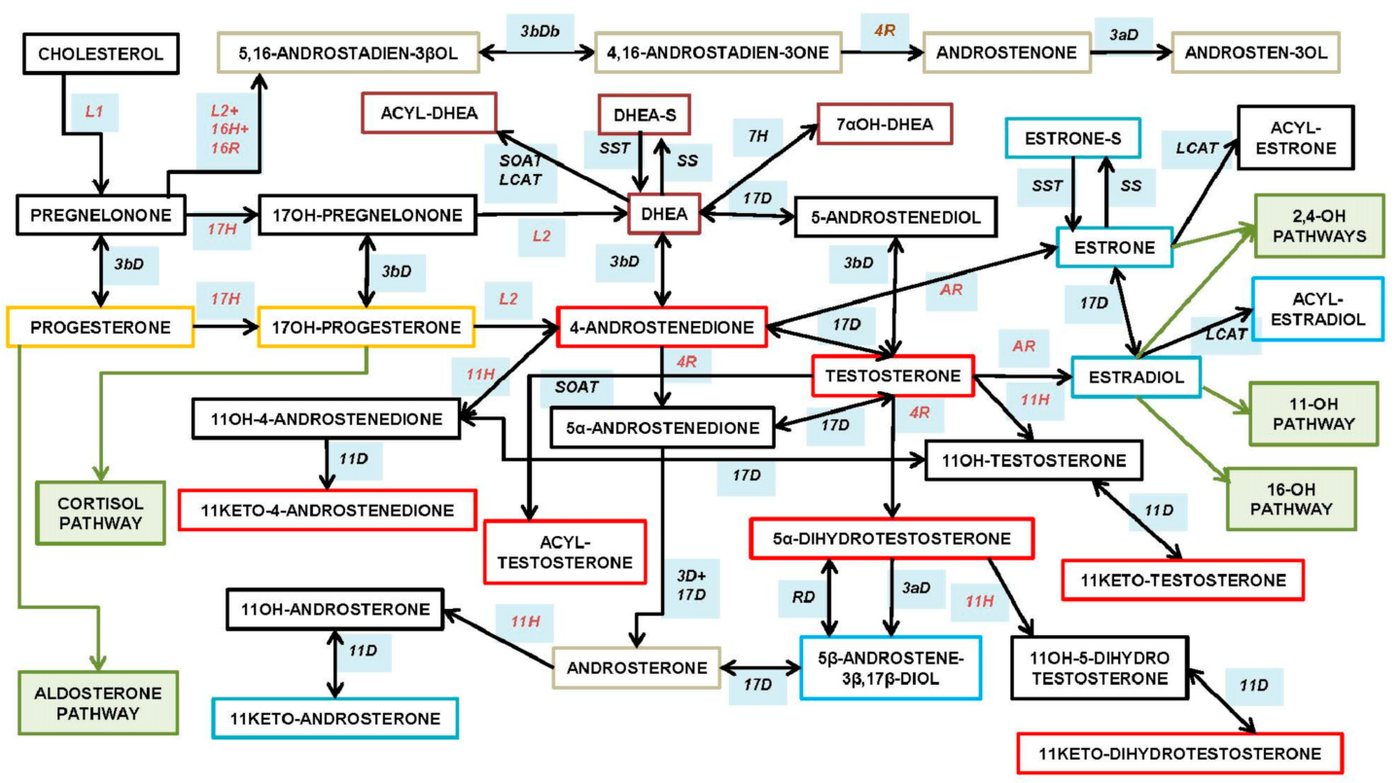
It starts with cholesterol. Yes, the thing they've painted as the enemy for thirty years.
Cholesterol becomes pregnenolone, the ancestor of all steroid hormones.
From there it branches. One path leads to progesterone, the other to DHEA. Both lead on to testosterone.
And that can then convert to estradiol, the female hormone a man needs too, just in small amounts, or to DHT, the stronger male form.
It's one tree, and its root is cholesterol.
Which leads to a conclusion worth the whole submodule: if someone drives your cholesterol down to the minimum, they've driven down the raw material for all your sex hormones.
Low cholesterol isn't a win. It's an empty warehouse.
⚙️ The engine of that line: the thyroid
Every step of that production is done by an enzyme. And almost every one of those enzymes needs thyroid hormone to work properly.
And here's a detail that often gets skipped.
The thyroid mainly makes T4, which is the storage, inactive form. Only in the tissues does it get converted to T3, the form that actually does the work.
A blood test can show values in the normal range while the conversion of T4 to T3 is stalling. And then the whole line stands still, no matter what it says on paper.
And this leads to a reverse reading of cholesterol
When the thyroid runs slow, cholesterol builds up in the blood instead of being converted into pregnenolone.
Pause on that.
High cholesterol isn't necessarily proof that you eat too much fat. It can be proof that your body can't keep up with turning it into hormones. And the thyroid itself isn't a standalone problem. It responds to minerals, to load, to light, to stress.
Most slowed-down thyroids aren't diseased glands. They're properly working glands in a broken environment.
🌱 And now the same thing through the terrain lens, because it changes what you do about it
The standard reading of a low number goes: you're missing a hormone, so we'll top it up.
The terrain reading goes differently: you're not missing anything. Your body decided not to produce.
Why this is a real difference, not semantics
Building is expensive. Muscle, fertility, appetite for risk, all of it costs raw materials and energy. The body only invests in it when it has the resources and when the conditions can carry it.
If he's been sleeping five hours, hasn't seen the sun and has been in alarm mode for three years, then lower production isn't a malfunction. It's the right decision by a body that assessed the situation.
And here's what matters: if you raise that number from the outside, you haven't given the body anything it was missing. You've overruled a decision that was correct under the circumstances.
It's the same logic as with fever in Module 1. A fever isn't the illness, it's a process. And whoever knocked it down didn't solve why it showed up.
What it means in practice
Don't read the number as a diagnosis. Read it as a balance sheet.
When it's low, ask what in the past year has been taken away from that list of four levers, not what to put into yourself.
And this applies to the thyroid too, as written above. A slowed gland in a broken environment isn't a defective gland.
Basal body temperature
American physician Broda Barnes spent forty years working with the thyroid and maintained that blood tests alone aren't enough.
He used a simpler measure: temperature taken in the morning right after waking up, while still in bed.
According to him, a consistently low morning temperature, roughly below 36.4 °C, means a slow metabolism, even when the blood work looks fine.
🎚 The four levers that run all of it
If testosterone is the result, what's the input? Four things you already know.
1. Light. The clock in your brain also controls the release of the hormone that tells the testes to produce. Without morning light, that signal arrives blurred. The problem isn't in the testes. It's that the control center never got the information about what time it is.
2. Food. Cholesterol and saturated fat as raw material. Eggs, butter, meat. Plus minerals, mainly zinc and magnesium, without which the enzymes don't run.
3. Sleep. This is where the hardest number in the whole submodule comes in, right below.
4. Calm. Long-term stress means chronically high cortisol, and the body has a clear order: survive first, only then build and reproduce. A man in constant alarm has a body with no reason to invest in building.
Four levers, and not one of them is sold in a pharmacy.
🔬 The hardest number: one week of sleep
Healthy young men slept five hours a night for one week.
Their daytime testosterone levels dropped by roughly ten to fifteen percent.
And the authors described it with a comparison worth remembering: a drop like that is equivalent to aging ten to fifteen years.
In one week. No pill, no supplement. Just sleep.
Source: JAMA, 2011, University of Chicago.
Your challenge for this submodule
Two numbers every morning, seven days.
Basal body temperature, right after waking, before you get up.
And how much you actually slept. Not how long you were in bed.
At the end of the week, look at both rows side by side.
Then ask yourself the question most men avoid: how much of my fatigue is a hormone problem, and how much is simply that I sleep five hours and don't see the sun all day?